
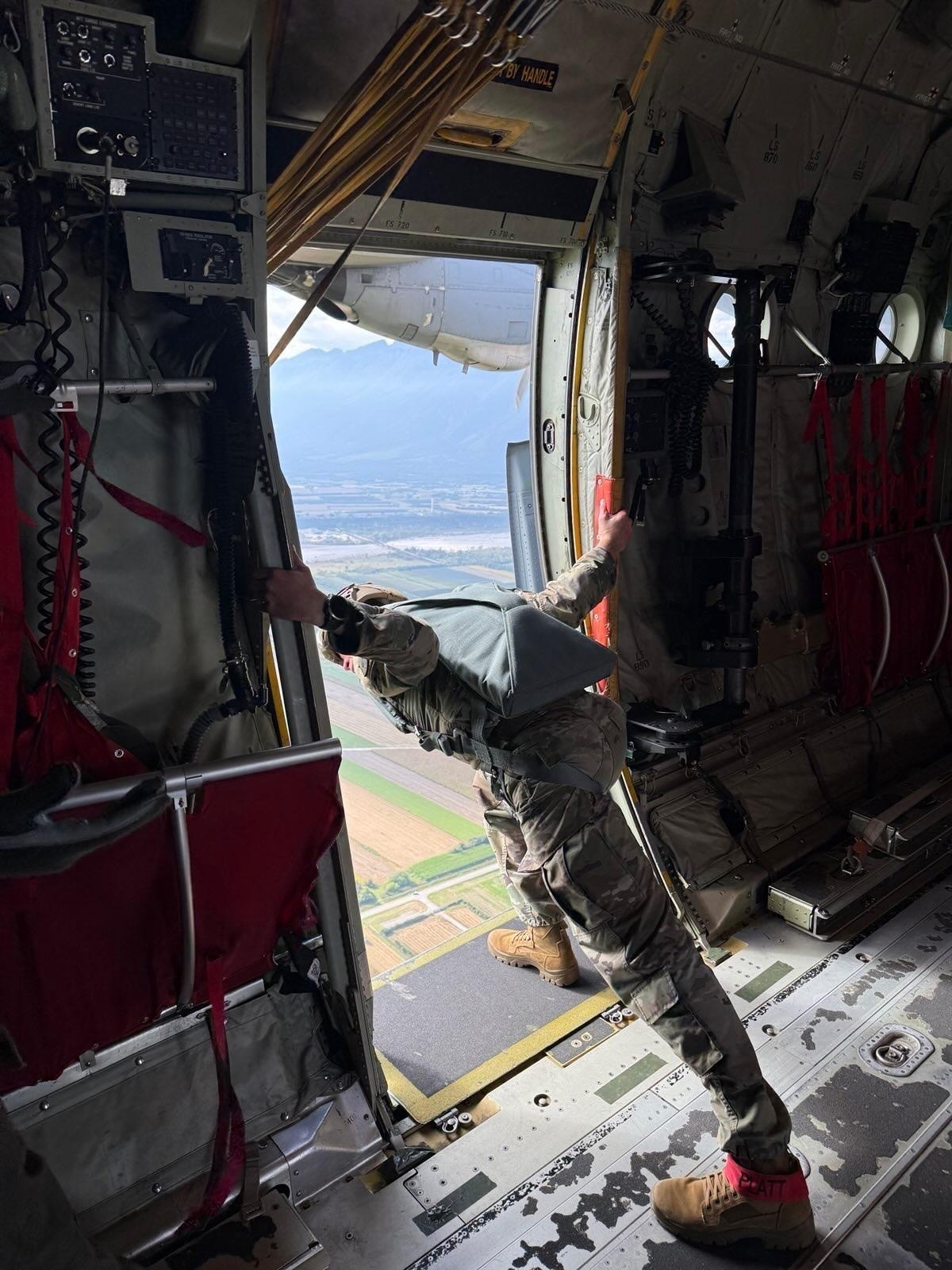
Inside a roaring C-130 cargo plane, the jump came down to seconds.
Sgt. Maj. Keith Platt stood at the aircraft’s open door, eyes locked on a steady stream of Army paratroopers moving toward the void below. As the mission’s final safety jumpmaster, Platt’s job was simple in theory—and unforgiving in reality: catch any mistake before gravity did.
Four paratroopers exited cleanly.
Then Platt saw the fifth.
Something was terribly wrong.
The soldier’s static line—the yellow cord that deploys the parachute—was stretched across his neck.
Platt didn’t hesitate.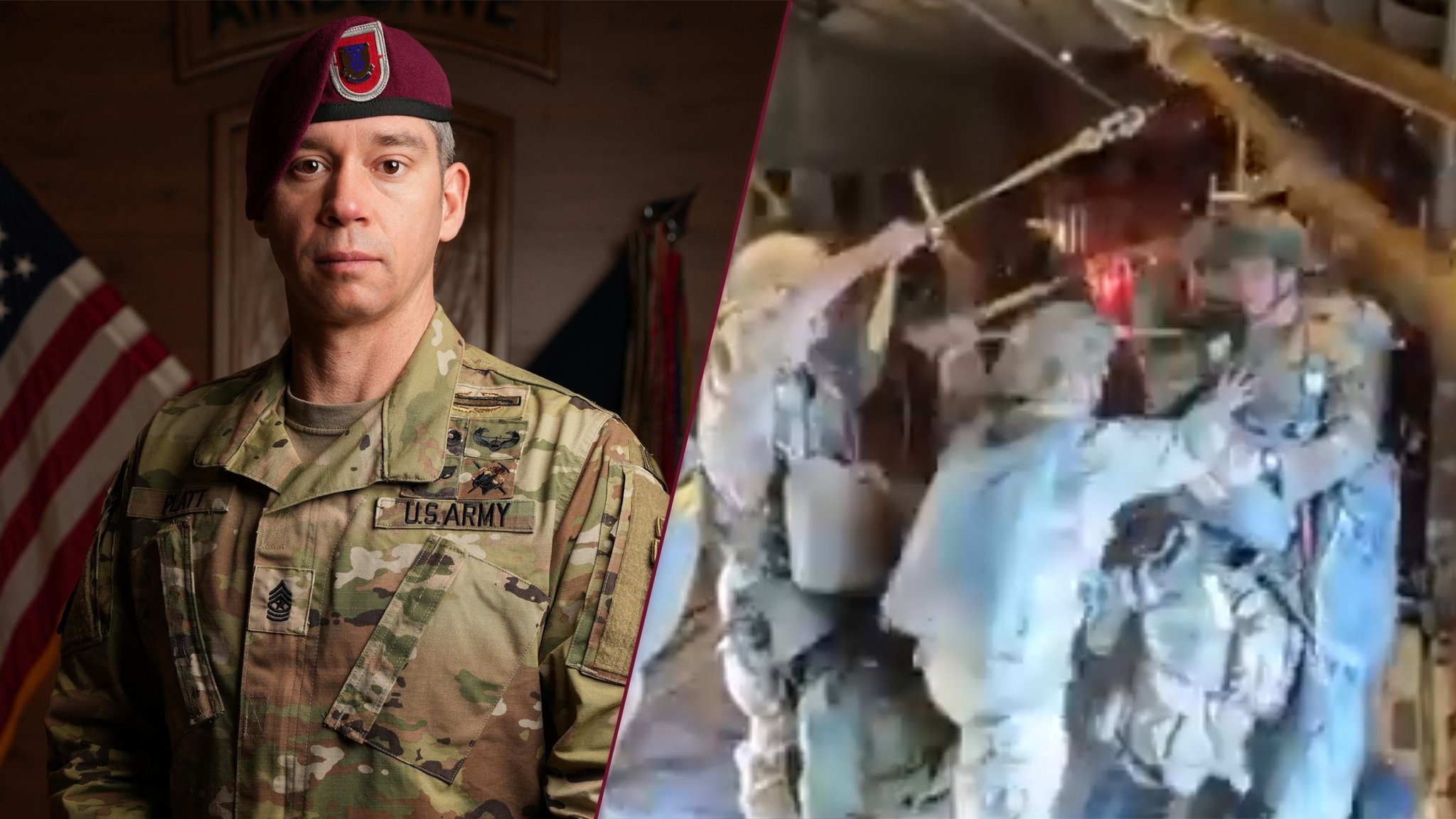
A Split-Second Decision
Platt knew instantly what would happen if the soldier jumped.
“When a jumper leaves the aircraft, the static line tightens,” Platt later explained. “Anything between that line and the aircraft is soft tissue. That’s where catastrophic injury happens.”
In Army terms, “catastrophic” can mean severe trauma or death.
A unit GoPro captured what happened next: Platt lunged forward, physically stopping the paratrooper mid-stride, shouting “Stop, stop, stop!” as he shoved the soldier back from the door.
The video went viral within days. Commenters hailed Platt as a hero.
Platt himself sees it differently.
“This Wasn’t Heroics”
“This incident doesn’t reflect heroics,” Platt said. “It reflects trained professionals doing their jobs in high-risk positions to keep paratroopers safe.”
Platt is the operations sergeant major for the 1st Battalion, 503rd Infantry Regiment, 173rd Airborne Brigade, based in Vicenza, Italy. He’s a senior jumpmaster with 56 jumps and previously trained jumpmasters at the 5th Ranger Training Battalion in Georgia.
On Nov. 17, he was one of several jumpmasters aboard the C-130 flying over the Juliet Drop Zone in Aviano, Italy, conducting a mass tactical airborne operation—known as a “mass tac.”
These jumps are among the most dangerous airborne missions: dozens of soldiers exiting tightly packed aircraft in rapid succession, sometimes just one second apart.
That margin for error is razor thin.
What Went Wrong
As the paratroopers filed toward the open doors, each soldier was responsible for maintaining control of their static line and handing it to Platt just before jumping.
The fifth paratrooper didn’t have his static line in hand.
As he moved forward, the line—anchored overhead—slid across his neck. It wasn’t fully wrapped, Platt clarified, but it didn’t need to be.
With jumpers exiting both doors at one-second intervals, Platt had about two seconds to spot the danger and act.
He stepped directly in front of the soldier, placed a hand on his shoulder, issued the stop command, and pushed him safely away from the aircraft opening.
As the video shows, Platt calmly untangled the static line from the soldier’s neck.
The paratrooper, caught in the chaos, didn’t even realize what had almost happened.
“In that moment, he was thinking, ‘What’s going on?’” Platt said. “There was no blame. No finger-pointing.”
A Lesson for Every Airborne Soldier
The aircraft made another pass over the drop zone. This time, the paratrooper exited safely.
For Platt, the takeaway is simple—and universal.
“If something isn’t right,” he said, “say something.”
The incident, he added, is also a reminder that airborne operations are never routine.
“This isn’t just about jumping to earn hazardous duty pay,” Platt said. “Every jump is training for the moment when it’s real—when lives depend on doing everything exactly right.”
In the end, what the viral video shows isn’t just a dramatic save.
It shows what happens when training, experience, and instinct collide at exactly the right moment—and how, sometimes, a life can be saved in the span of a heartbeat.


