
Britain’s fiscal watchdog has admitted it underestimated Government borrowing by around £60billion across successive forecasts in a fresh setback for Chancellor Rachel Reeves and her economic strategy.
The Office for Budget Responsibility (OBR) published its latest evaluation report on Tuesday, acknowledging substantial inaccuracies in its projections for borrowing and economic growth.
The watchdog also conceded it had been overly optimistic about the economic impact of Ms Reeves’s £25billion increase to employer national insurance contributions (NICs).
The assessment comes at a politically difficult moment for the Chancellor as pressure mounts over the state of the economy, public finances and Labour’s wider fiscal plans.
The OBR’s forecasts for the 2024/25 financial year proved particularly inaccurate.
In March 2023, the watchdog projected borrowing would total £85billion, while its March 2024 estimate put the figure at £87billion.
Actual borrowing eventually reached approximately £151billion, leaving forecasting gaps of £66billion and £65billion respectively.
The watchdog said persistently high inflation and elevated interest rates played a major role in the forecasting errors by increasing both debt interest payments and welfare spending beyond expectations.
The lasting impact of the global energy price shock following Russia’s invasion of Ukraine in 2022 also proved more severe than originally anticipated.

Ms Reeves’s first budget in October 2024, which included around £70billion in additional day-to-day spending and public investment, also pushed borrowing significantly above earlier projections.
The OBR acknowledged its forecasts for economic growth had also been “too optimistic”.
Britain’s economy expanded by just 1.4 per cent in 2025 compared with the two per cent growth rate previously forecast by the watchdog.
The OBR stated: “In broad terms, this could be because our pre-measures forecast was too optimistic, our assessment of policy effects was too optimistic, or some combination of the two.”
Economists have increasingly linked rising unemployment to the Chancellor’s national insurance rise, which significantly increased hiring costs for businesses.
Youth unemployment has climbed to 16.2 per cent, marking its highest level in more than a decade.
The OBR’s report suggested the impact of the employer national insurance increase on economic activity had been greater than initially expected when the policy was announced nearly two years ago.
A cyberattack that forced temporary shutdowns at Jaguar Land Rover factories also weighed on growth during the period.
The watchdog revealed it had now “adjusted our analytical and modelling toolkit” in response to the continuing US-Israeli conflict involving Iran.
The comments raised the prospect of weaker projections being presented to the Chancellor ahead of the autumn budget should tensions in the region continue.
Private sector economists generally proved more accurate than the OBR in forecasting economic growth, although both groups underestimated borrowing levels.
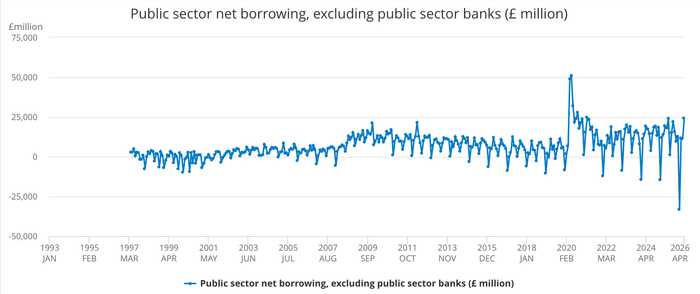
Fresh figures published by the Office for National Statistics (ONS) showed borrowing in April reached £24.3billion.
That figure exceeded the OBR’s spring statement forecast by £3.4billion.
However, borrowing for the full financial year to March 2026 provided some relief for the Government.
Total borrowing reached £129billion across the year, representing a £23billion fall from the previous financial year and coming in £3.7billion below the watchdog’s forecast.


