
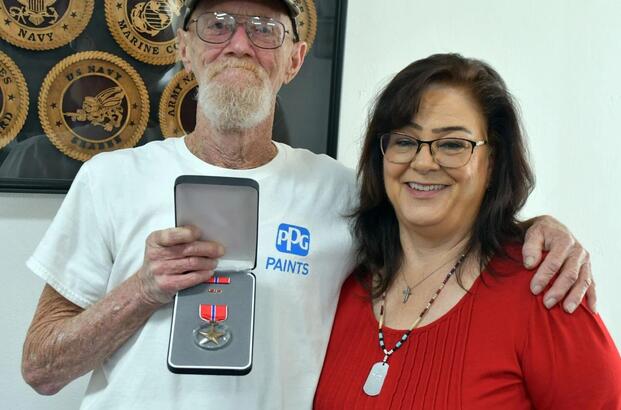
 Army veteran George Layman has finally received the honor many believe he earned more than half a century ago. Though he never called himself a hero, Layman’s actions during the Vietnam War — especially in the brutal battle known as Hamburger Hill — made him deserving of the Bronze Star decades before the medal was placed in his hands.
On Nov. 25, at the headquarters of Honoring/Hiring/Helping Our Heroes of Pinal County (HOHP), the 76-year-old Arizona veteran was formally recognized. Jeff Timm, a liaison for Congressman Eli Crane, presented Layman with his long-awaited Bronze Star along with several additional service medals.
A Radioman on One of Vietnam’s Bloodiest Hills
Layman served in Vietnam from 1968 to 1970 as a radio operator — a job that placed him directly in the line of fire. In May 1969, he was thrust into the infamous battle on Dong Ap Bia, later known worldwide as “Hamburger Hill.” The name came from the sheer carnage: during the week-long assault on Hill 937, 56 American soldiers were killed and many more wounded.
Despite having the service record required for a Bronze Star, Layman never received the medal at the time. He isn’t entirely sure why it took more than 50 years for the recognition to arrive. The Bronze Star is awarded to those who demonstrate heroic or meritorious achievement in a combat zone — something Layman undeniably did.
He believes his involvement with HOHP helped bring attention to his overlooked wartime accomplishments.
“I don’t think I was a hero,” Layman told PinalCentral. “It’s nice to finally have the medals. I always wanted them, but I never did anything about it until I joined HOHP.”
Though Hollywood turned the battle into a 1987 film, Layman has never watched it.
“I still haven’t seen that movie,” he said quietly. “I lived it.”
A Combat Role That Painted a Target on His Back
As a radioman, Layman was essential on the battlefield — and a prime target for enemy forces. His job was to relay information about North Vietnamese movement back to commanders, often while under direct fire.
“It took more than four companies to climb that mountain,” he recalled. “Each company was 60 to 80 men. We lost around 60 guys. We expected 2,000 enemy soldiers at the top. When we finally reached it after a week, all we found was a big hole straight down. Three days later, we left and never went back.”
Kim Vandenberg, director of HOHP, said the organization was proud to witness Layman finally receive the Bronze Star. She plans to locate Layman’s original nomination documents to fully confirm the details of his award.
“George earned that Bronze Star,” she said. “They’re not handed out lightly. We will find out exactly what led to his nomination.”
Humble, Even in Recognition
Layman’s quiet humility didn’t surprise those who know him. Many Vietnam veterans carry complicated feelings about the war — and about being honored for their role in it.
“Every veteran has a different perspective,” Vandenberg said. “Some don’t want their medals at all because of what they went through. Everyone’s experience is unique.”
Another Bronze Star recipient, Abraham Ortega — who also served in Vietnam — attended the event. Even though he and Layman had never crossed paths during their service, Ortega said all Vietnam veterans share a deep sense of brotherhood.
“We stepped up as young men and signed a blank check to do a job,” Ortega said. “We did it with honor and pride. Watching George today, I felt like we could’ve been related. We never met in Vietnam, but he was there — doing what he had to do.”


