
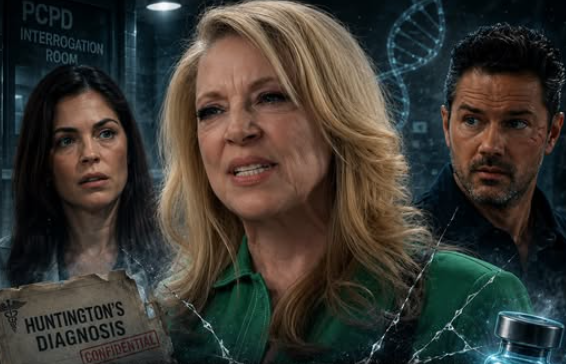
 For years, the story of Britt Westbourne’s Huntington’s disease has been told as a tragedy of inheritance — a daughter condemned by her father’s blood, fighting a countdown she cannot stop. That story is a lie. And on May 26th, in a single exchange at the PCPD interrogation room, Liesl Obrecht revealed that she is already beginning to see through it.
When “Nathan” told Liesl they had to find Britt before she died of Huntington’s, Liesl did not reach for her phone. She did not break down. She asked him a clinical question: his sister’s Huntington’s had shown no sign of worsening — so why did he believe she was going to die? That question is not the reaction of a frightened mother. It is the opening move of a physician who has just identified a contradiction she cannot explain away.
Here’s what actually happened to Britt Westbourne — and what Liesl is now piecing together. Huntington’s disease is a progressive, irreversible neurological condition. It does not plateau. It does not go silent. Every year without treatment, the damage compounds. There is no approved medication in existence that can eliminate all clinical evidence of the disease in a patient who genuinely has it. And yet, when Lucas Jones examined Britt in September of last year, he found zero neurological signs of Huntington’s. Not reduced. Not managed. Zero. That is not a treatment outcome. That is a diagnostic impossibility — unless Britt never had the disease to begin with.
The evidence is clear: Cullum and Sidwell did not save Britt Westbourne. They manufactured her dependency. The most likely scenario is not that their experimental drug is a miracle compound that outperforms every known treatment in medical history. The most likely scenario is that Britt was either misdiagnosed from the start — her test results altered before she ever saw them — or that the drug Cullum has been administering is not treating a disease at all. It is creating one. A synthetic dependency, calibrated to mimic Huntington’s symptoms upon withdrawal, designed to ensure that Britt will never stop needing what only Cullum can provide.
This is the mechanism of the trap. Britt believes she is sick. She believes the drug is the only thing standing between her and a death she inherited from her father. So she cooperates. She stays. She finishes the research. She does not run — until Rocco gave her a reason to. And now she is on the road, somewhere between Port Charles and Berlin, with a teenage boy and a supply of medication that will eventually run out. When it does, she will not experience the slow decline of Huntington’s disease. She will experience withdrawal from a compound specifically engineered to feel like exactly that — and she will have no way to know the difference.
This proves that Cassius’s urgency in the interrogation room was never about Huntington’s disease. It was about the drug clock. He knows how much Britt had when she left. He knows how long it lasts. He knows what happens to her body when it runs out. When he told Liesl that Britt would die if they did not find her in time, he was not describing a disease progression. He was describing a withdrawal timeline — and he gave himself away to the one person in Port Charles qualified to recognize it.
Liesl Obrecht is now the most dangerous person in this storyline — not because she has a weapon, but because she has a question that Cullum and Sidwell cannot afford to have answered. If she pulls Britt’s full medical history, if she contacts Lucas Jones, if she runs an independent genetic panel on any sample she can obtain, the entire architecture of the con collapses. No Huntington’s diagnosis. No legitimate treatment. Just a woman who was told she was dying so that two men could own her completely.
The cruelest part of this story is not what Cullum did to Britt. It is what Britt has done to herself because of it — the years of compliance, the research she completed, the life she surrendered, all to survive a disease she may never have had. Liesl is standing at the edge of that truth right now. She does not have all the pieces yet. But she has the most important one: the knowledge that her daughter’s condition does not match the story the man claiming to be her son is telling. And in General Hospital, that kind of knowledge has a way of becoming the thing that brings everything down.


