
A new public opinion poll shows that most Americans want the United States to play a leading role in global affairs, with strong support for aiding Ukraine and defending Taiwan.
The findings come from the annual Reagan National Defense Survey, released Thursday by the Reagan Institute, which polled 2,507 U.S. adults between October 23 and November 3.
Why It Matters
The survey reveals broad backing for active U.S. engagement abroad, supported by long-standing alliances such as NATO — a stance that contrasts sharply with the “America First” approach of former President Donald Trump’s administration.
More than half of respondents (55%) expressed confidence that the U.S. maintains military superiority over China. Additionally, 44% said America should keep a military large enough to fight separate wars against China and Russia simultaneously.
These results may encourage Ukraine and Taiwan at a time when both face rising threats from authoritarian neighbors — though whether public opinion will lead to concrete government action remains uncertain.
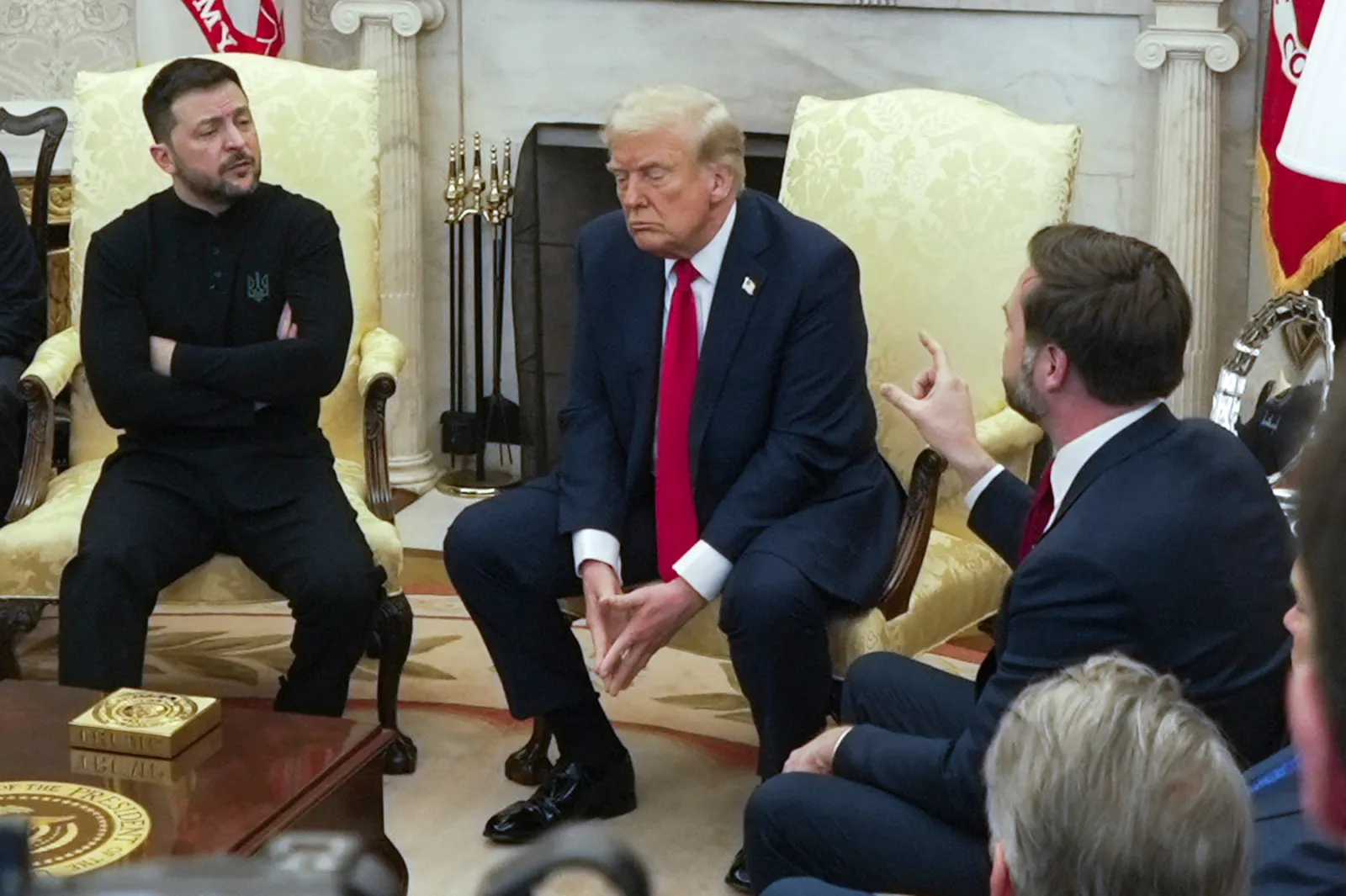
Vice President JD Vance, right, speaks with Ukrainian President Volodymyr Zelensky, left, as President Donald Trump listens in the Oval Office at the White House, February 28, 2025, in Washington, D.C. | Mystyslav Chernov/AP Photo
Key Findings
Sixty-four percent of Americans said the U.S. should be more engaged and take the lead internationally. An overwhelming 87% believe it’s important for the U.S. to have the world’s most powerful military, and 71% agree global peace is more likely when the U.S. is the strongest power.
According to the Reagan Institute, the data shows that Americans want the U.S. to lead globally, maintain a military capable of deterring authoritarian adversaries, and support allies defending freedom.
The poll found that 62% of Americans — including 57% of Republicans and 72% of Democrats — want Ukraine to win its war against Russia. Support for sending U.S. weapons to Ukraine climbed nine points to 64%.
China remains the top perceived threat, cited by 48% of respondents, followed by Russia at 26%. Furthermore, 87% expressed concern about the growing cooperation among China, Russia, Iran, and North Korea.
Approval of NATO reached its highest level since the survey began, with 68% viewing the alliance favorably. Although Trump has questioned America’s role in NATO, concerns about the U.S. leaving the alliance have eased as European members boost defense spending.
Public support for defending Taiwan has also surged since 2024. China claims the self-governing island and has threatened force if necessary to seize it.
This year’s data shows:
-
70% would support moving U.S. military assets to the region if China attacked Taiwan (up 12 points)
-
71% support sending more military equipment (up 15 points)
-
60% would back committing U.S. forces to Taiwan’s defense (up 12 points)
The institute said support for defending Taiwan is “strong, bipartisan, and growing.”
The poll also shows majority support for using U.S. military force against suspected drug traffickers in Latin America and the Caribbean, with 62% in favor — though this view is heavily split politically: 90% of self-identified MAGA Republicans support the idea compared with 36% of Democrats.
However, the survey also reveals a long-term decline in confidence in the U.S. military as an institution. Only 49% of Americans said they have a great deal of confidence — a drop of 21 points since 2018, though similar to last year’s result. The decline stems from a widespread belief that the military has become politicized.
Confidence levels have diverged sharply by party: 67% of Republicans express strong confidence in the military, compared with only 33% of Democrats.
Forty-nine percent of respondents said they trust the military to win a war abroad (up 5 points since 2022), and 45% believe it can deter foreign aggression (up 3 points).
On technology, 68% support major investments in developing the Golden Dome missile-defense system to protect the U.S. from long-range threats. But views on integrating artificial intelligence remain mixed: 27% say expanding AI use in the military is a good idea (up from 20% last year), while 24% disagree (down from 27%).
What People Are Saying
Rachel Hoff, policy director at the Reagan Institute, told Newsweek that Americans consistently prefer global leadership over withdrawal. Nearly two-thirds now say the U.S. should be more engaged internationally.
She also noted that MAGA Republicans strongly support U.S. global leadership, and that Trump himself has rejected the idea that the MAGA or America First movements are isolationist.
Hoff said support for defending Taiwan, aiding Ukraine, and deterring Iran aligns with what Trump’s voters prefer — a “peace through strength” approach.


