
Andy Burnham is facing a warning from the Office for Budget Responsibility (OBR) that future governments must find £120billion through higher taxes or spending cuts to keep national debt at its current level.
The OBR said persistent tax rises could eventually drive around two million workers out of the labour force by 2075 as Britain grapples with rising public spending and an ageing population.
The watchdog projected that government debt could rise sharply over the coming decades unless action is taken to address mounting fiscal pressures.
Britain’s tax burden has already reached its highest level since the Second World War, according to the OBR’s latest analysis.
Mr Burnham has not yet set out how he would fund his wider policy ambitions while also easing pressure on household finances.
The OBR said successive governments have increasingly relied on tax rises to strengthen the public finances, warning there are limits to how far that approach can be sustained.
The watchdog also warned that so-called stealth taxes could become more difficult to maintain as artificial intelligence reshapes the labour market and potentially reduces employment.
Income tax thresholds were frozen in cash terms under former prime minister Rishi Sunak until 2028, with Chancellor Rachel Reeves later extending the policy into the next decade.
The policy has drawn more workers into higher tax bands through fiscal drag as wages have risen while thresholds have remained unchanged.
According to the OBR, around five million additional workers have already been brought into the higher and additional rate tax bands, including nurses, teachers and supermarket managers.
The watchdog warned that if future governments continue increasing thresholds only in line with inflation rather than earnings, more than 20 million people, equivalent to around two-thirds of workers, could become higher-rate taxpayers over the coming decades.
It said even full-time workers earning the minimum wage could eventually pay the higher rate of income tax under that scenario.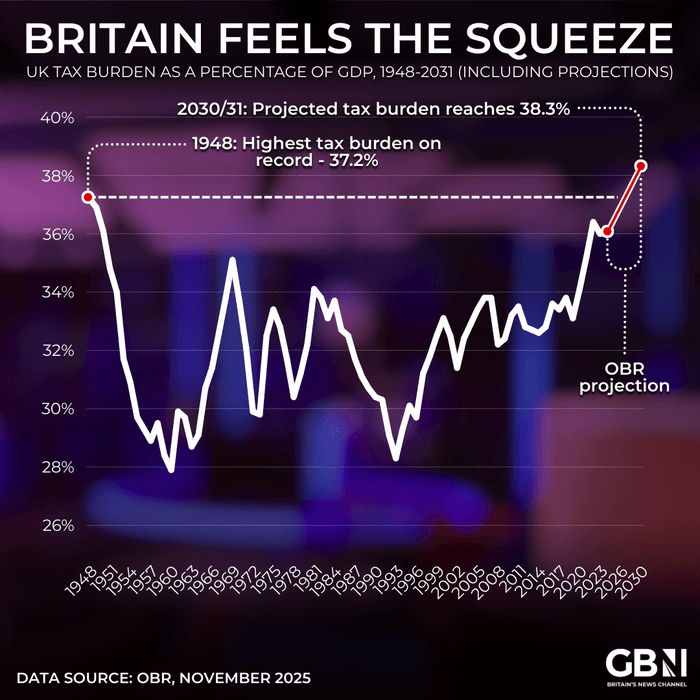
The OBR also forecast Government spending would increase from around 40 per cent of GDP at the start of the decade to 49 per cent by the mid-2070s.
It said rising NHS costs, an ageing population and increasing state pension spending could push national debt towards 300 per cent of GDP within the next 50 years.
David Miles, an OBR executive member, said: “It would be painful, because… if you carry on doing that decade after decade, it isn’t too far down the road until the great majority of people are higher rate taxpayers.”
He added the policy would affect people’s “willingness to work, willingness to stay in the UK [and] to save.”
Mr Miles also warned Britain was “catching up” with continental European tax levels, arguing that the economic damage caused by further increases would rise “exponentially” rather than incrementally.
The OBR identified the triple lock on the state pension as one of the biggest long-term pressures on the public finances.
It said linking the state pension only to average earnings would reduce projected spending by around one-fifth, while linking it solely to inflation would reduce expenditure by around two-fifths, equivalent to approximately £160billion a year in today’s money.
Lord O’Neill of Gatley, who is expected to become one of Mr Burnham’s chief economic advisers, described the triple lock as “bonkers” earlier this year.
Mr Burnham has pledged to retain the triple lock despite those comments.
Former chancellor Jeremy Hunt said: “The OBR makes it clear that unless we tackle the triple lock we will end up with totally unsustainable levels of both tax and debt.”


