
The NHS has warned its staff to prepare for a possible Ebola outbreak in Britain, with medics urged to isolate patients and stock up on PPE.
As the deadly disease continues to rip through Africa, the UK Health Security Agency (UKHSA) has told hospitals and frontline services across the country to stand ready to identify and isolate potentially infected patients.
The agency has warned that although the likelihood of an outbreak in Britain remains low, there is a risk of cases being imported from abroad.
Hospitals have been urged to ensure staff are up-to-date with case management protocols and check they have sufficient levels of PPE in stock.
Healthcare providers have been told to consider the possibility of Ebola in any patients with a history of fever, is acutely unwell and has travelled from the Democratic Republic of Congo (DRC) or Uganda in the past three weeks.
The outbreak of the rare Bundibugyo strain was declared a public health emergency of international concern by the World Health Organisation (WHO) last month, and the disease is still ripping through communities in the DRC and Uganda.
Hundreds of cases and dozens of deaths have been confirmed, according to the most recent figures.
However, as testing and surveillance of the disease improves, more casualties are expected to be registered.
As more suspected cases remain under investigation by African health authorities, officials have warned the true scale of the outbreak may be higher.
Investigators are currently examining more than 1,100 suspected cases across both nations, with the death toll currently standing at 43 confirmed fatalities.
The Bundibugyo strain is particularly difficult to combat due to a lack of approved medical countermeasures.
The UKHSA has sought to reassure the public, stressing that the risk to Britain remains extremely low and that the NHS has specialist high-containment units and procedures in place to manage any isolated cases that may arrive.
UK-Med and Healthy World, Secure Britain spokesman Dr Derek Sloan said: This outbreak, along with the recent Hantavirus cases on a cruise ship and meningococcal meningitis infections in the UK, shows how important it is that we stay vigilant and use effective public health tools to protect our populations.
“Infectious disease outbreaks such as these in our interconnected world cannot be dismissed as someone else’s problem.
“Incredible institutions across Britain act as our first line of defence in an unpredictable world when the frequency of infectious disease outbreaks is increasing.
“Working with others around the world is the best way for countries like the UK to fulfil our responsibilities as global citizens, but also to protect ourselves and the world from future threats to global health security.”
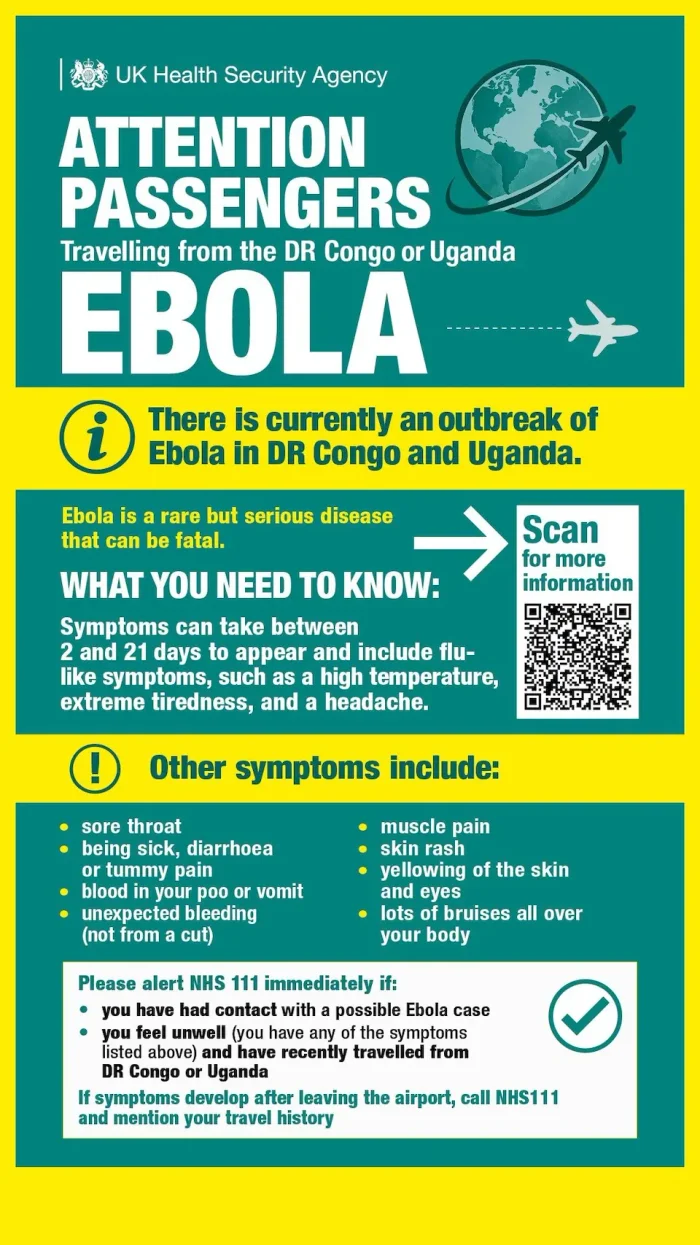
The UKHSA’s warning comes as posters with Ebola messaging begin to appear at major British travel hubs.
The displays – aimed at those who have recently travelled from the DRC and Uganda – contain valuable information on symptoms and what to do if a person believes they may be infected.
The messaging has been spotted at Heathrow, Gatwick and Manchester airports, as well as Birmingam and St Pancras train stations.
There are direct flights to Britain from Uganda weekly, while travellers from the DRC are able to come into the country via connecting flights from Paris and Brussels.


