
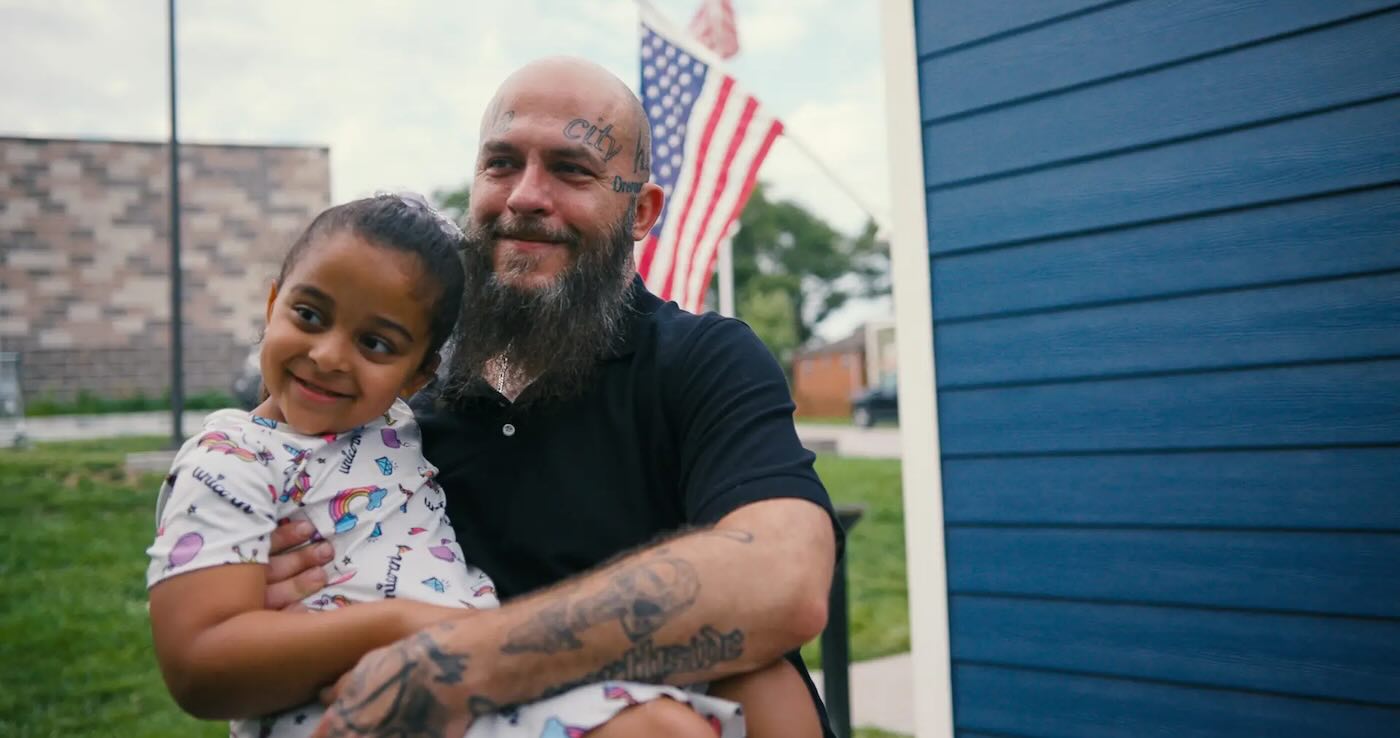
When Tim’s two-year-old daughter, Majesty, was placed into foster care, the hardest part wasn’t proving that he loved her.
It was proving that he had an address.
At the time, Tim was doing everything right. A U.S. Navy veteran, he had fought his way out of addiction and was nearly two years into recovery at a residential treatment program in Missouri. He was sober. He was committed. He was ready to be a father.
But the system didn’t see it that way.
The group home where Tim lived was designed for recovery, not families. Children weren’t allowed, and family court rules were unforgiving. Without a permanent address of his own, Tim couldn’t regain custody of his daughter — no matter how hard he was trying.
“I just remember thinking,” Tim said, “‘How can I rescue my daughter?’”
The answer came in an unexpected form: a tiny blue house.
Through a program manager who knew his story, Tim was connected to Veterans Community Project (VCP) — a nonprofit village built specifically to help veterans rebuild their lives. Among the small homes designed for individuals were a few larger family units, created to help parents reunite with their children.
Within days, Tim moved into his own place.
Not long after that, he got full custody of Majesty.
Soon, father and daughter upgraded to a family unit — complete with a bunk bed perfectly sized for a toddler. For the first time, Tim could close a door behind him and say, This is home.
“Majesty loved it,” he said, smiling at the memory. “She’d run around dressed like Princess Elsa. Everyone doted on her.”
But Tim wasn’t just focused on the present. He was building a future.
While living at the Village, he enrolled in school and worked toward becoming a licensed drug counselor. A year and a half later, on his very first day on the job, he found himself sitting in a courtroom — not as a defendant, but beside the judge.
“I remember thinking, ‘I never thought I’d be on this side,’” he said. “Especially knowing who I used to be.”
That past had been long and heavy.
After serving three and a half years in the Navy in the early 2000s, Tim struggled with the transition back to civilian life. Old childhood trauma resurfaced. Addiction took hold. For nearly two decades, his life unraveled — until he became one of more than 30,000 veterans experiencing homelessness.
“I was lost,” Tim said quietly. “I lived under bridges. Slept in abandoned cars. It’s hard to explain how exhausting it is just to survive.”
His turning point came when he finally accepted that he couldn’t do it alone.
“The opposite of addiction is connection,” he said. “And that’s what I found.”
At the rehab center, Tim experienced something unfamiliar — unconditional care. People prayed with him. Believed in him. Loved him when he couldn’t love himself. He compared the experience to A Christmas Carol.
“I felt like Scrooge,” he said. “Like my heart was finally opening.”
Faith had shaped his life before — even earlier than that.
Years prior, when he was young and directionless, Tim had a dream. In it, he believed God told him to become a journalist in the Navy. He laughs when he tells the story — but he means every word.
Though he wasn’t particularly religious or patriotic at the time, he listened. He walked into a recruiting office, scored exceptionally well on the ASVAB, and joined the Navy in a public affairs role. Today, those same communication skills help him reach people who are exactly where he once was.
In his office near Kansas City’s city hall, Tim meets clients with empathy — and credibility. A tattoo above his eyebrows reading “Killa City” is a remnant of another life, but one he doesn’t hide.
“It makes me relatable,” he joked. “They know I’ve been there.”
One day, during a presentation for former clients, reality hit him all at once. He walked into a room filled with 40 or 50 people who stood up, smiling and calling his name.
“I didn’t realize how many lives I’d touched until that moment,” he said.
At home, another reminder waits for him every day.
Majesty is now seven years old, thriving in second grade. She simply calls him Dad.
They cook together. Draw together. Read together. Explore together. Just be together.
“She’s bright. She’s loving. She’s got the most amazing imagination,” Tim said.
All of it — the stability, the family, the future — began with something many people take for granted: a place to live.
At 40 years old, moving into Veterans Community Project gave Tim more than a roof. It gave him dignity, structure, and a path forward.
“They surrounded me with love,” he said. “And they gave me a plan. And it worked.”
Tim paused, then smiled.
“I’m just so very thankful to have Majesty in my life.”
Sometimes, kindness doesn’t look dramatic.
Sometimes, it looks like a small blue house — and a father finally able to bring his daughter home.


